

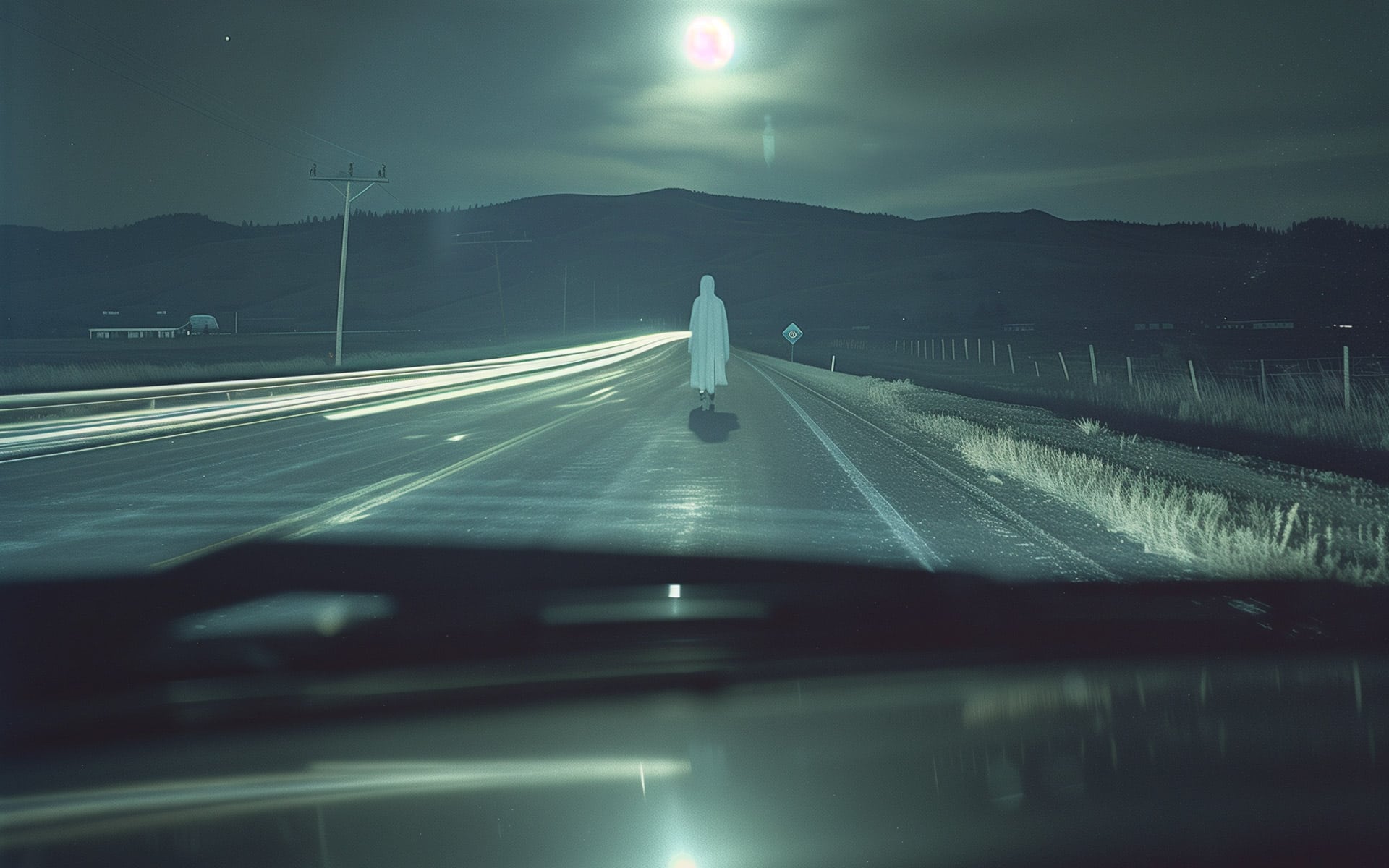
The story of the Phantom Hitchhiker typically begins on a foggy or stormy night, with a driver encountering a seemingly normal person along a desolate stretch of road near Black Horse Lake. The figure, often described as a young woman, is dressed in a manner that seems out of place, typically in outmoded clothing, which is not immediately noticed by the driver. She requests a ride to a nearby destination. During the drive, she may engage in minimal conversation or remain eerily silent. Just as the destination approaches, the driver discovers that the hitchhiker has disappeared from the backseat, leaving no trace of her ever being there.
Over the years, motorists had reported eerie encounters with the Phantom Hitchhiker, their stories whispered in hushed tones at roadside diners and local watering holes. Some spoke of seeing a young woman dressed in tattered clothes, her face obscured by the shadows, while others claimed to have felt a chill wind sweep through their car as they passed by the spot where she was said to appear.
One such encounter occurred on a fog-shrouded night, as a weary traveler made his way home along the lonely road that skirted the edge of Black Horse Lake. As he rounded a bend, he spotted a figure standing by the side of the road, her form bathed in the ethereal glow of the moon.
With a pang of sympathy, the traveler slowed his car to a stop, rolling down the window to offer the young woman a ride. But as she climbed into the backseat, he felt a chill run down his spine, the hairs on the back of his neck standing on end.
The woman said nothing as the car sped along the deserted highway, her presence a silent weight that hung heavy in the air. And then, as suddenly as she had appeared, she was gone, vanishing into thin air without so much as a word of thanks.
The traveler drove on in stunned silence, his mind reeling from the encounter. Had he just picked up a ghost on the side of the road, or was it merely a trick of the light playing tricks on his weary mind?
But the legend of the Phantom Hitchhiker was not confined to chance encounters on moonlit nights. Over the years, local citizens had reported strange occurrences and unexplained phenomena that seemed to be connected to the ghostly figure that haunted the roadside.
One such tale spoke of a young couple who had been out for a late-night drive when they spotted the Phantom Hitchhiker standing by the side of the road. Ignoring the warnings of their friends, they stopped to offer her a ride, only to watch in horror as she vanished into thin air before their very eyes.
Another story told of a group of teenagers who had dared each other to spend the night by the lake, hoping to catch a glimpse of the legendary ghost. As they huddled around a campfire, swapping ghost stories and nervously laughing off their fears, they heard a soft voice calling out to them from the darkness.
At first, they dismissed it as a trick of the wind, but as the voice grew louder and more insistent, they realized with mounting horror that it belonged to the Phantom Hitchhiker herself. In a panic, they fled into the night, their screams echoing through the darkness as they ran.
But perhaps the most chilling tale of all was that of the local farmer who had stumbled upon the Phantom Hitchhiker’s grave while plowing his fields one summer’s day. According to legend, the young woman had died tragically in a car accident many years before, her body never recovered from the depths of Black Horse Lake.
As the farmer stood gazing down at the weathered headstone, he felt a cold hand close around his heart, the weight of centuries of sorrow pressing down upon him. And in that moment, he knew that the legend of the Phantom Hitchhiker was far more than just a ghost story—it was a warning, a reminder of the dangers that lurked in the shadows of the night.
And so, as the sun set over Black Horse Lake and the shadows lengthened across the winding road, the townsfolk whispered tales of the Phantom Hitchhiker, their voices tinged with fear and reverence for the ghostly figure that haunted their dreams. For in the darkness, where the line between the living and the dead blurred and twisted, anything was possible, and no one was safe from the grasp of the supernatural.
The Psychology of the Legend
Narratively, the Phantom Hitchhiker trope serves several functions. It plays on the common fear of the unknown and the inherent eeriness of desolate roads at night. The inclusion of specific details like the location of Black Horse Lake and the apparition’s consistent appearance adds a layer of authenticity that makes the legend more tangible and relatable to the local population. The vanishing act serves as a chilling climax that reinforces the supernatural elements of the story.
Culturally, the Phantom Hitchhiker of Black Horse Lake taps into broader themes in folklore, such as the crossing of paths between the living and the dead. This story may be seen as a modern echo of ancient myths where spirits seek the help of the living to complete unfinished tasks or convey messages from the beyond. It also aligns with the psychological concept of the “return of the repressed,” where societal anxieties manifest as collective myths and legends.
Furthermore, this particular legend underscores a cultural fascination with ghost stories and paranormal phenomena, especially in places that seem isolated or stuck in time. Black Horse Lake, with its remote and eerie ambiance, provides the perfect backdrop for such supernatural occurrences. The setting amplifies the tale’s impact by enhancing the solitary and vulnerable state of the motorist, which resonates with the universal fear of being alone in the face of the inexplicable.
The persistent popularity of the Phantom Hitchhiker story also sheds light on the role of storytelling in community identity and continuity. Such legends are often shared as cautionary tales or thrilling campfire stories that serve to bond the community through shared experiences and common fears. In this way, the Phantom Hitchhiker becomes a part of the local lore, reinforcing community bonds and establishing a collective narrative for the inhabitants of the area around Black Horse Lake.
In a broader sense, the story of the Phantom Hitchhiker serves as a vehicle for exploring the boundaries between life and death, reality and superstition. It prompts listeners to question their understanding of the world and confront their beliefs about the supernatural. This confrontation with the unknown can be both a thrilling and a deeply unsettling experience, which is why stories like these continue to captivate.
Moreover, the Phantom Hitchhiker phenomenon is not unique to Montana; similar stories are found across various cultures worldwide, suggesting a universal psychological underpinning. These stories often serve as a mirror reflecting the values, fears, and the socio-cultural environment of the community. They provide insights into how different societies deal with themes of death, the afterlife, and the supernatural, each adding unique elements that reflect their specific cultural context.
In conclusion, the Phantom Hitchhiker of Black Horse Lake is more than just a chilling tale meant to scare those who travel its lonely roads—it is a complex narrative intertwined with cultural symbolism, psychological intrigue, and deep-rooted human fears. This legend, like many others, persists because it engages with fundamental questions about existence and the human condition, providing a mysterious and supernatural framework through which these questions can be explored. Whether as a form of entertainment, a moral lesson, or a symbolic story, the Phantom Hitchhiker continues to haunt the collective imagination, ensuring its place in the folklore of Montana and beyond.

